Friday, October 27, 2017

Vengeance of the Lichemaster: Warrior Monks of La Maisontaal


What's that? You want more obscure Citadel miniatures to populate the Vengeance of the Lichemaster? Have you done your chores? Have you watered the gimp? Walked the polyp? Recited the Litany Against Fear? Well OK then. You deserve this.

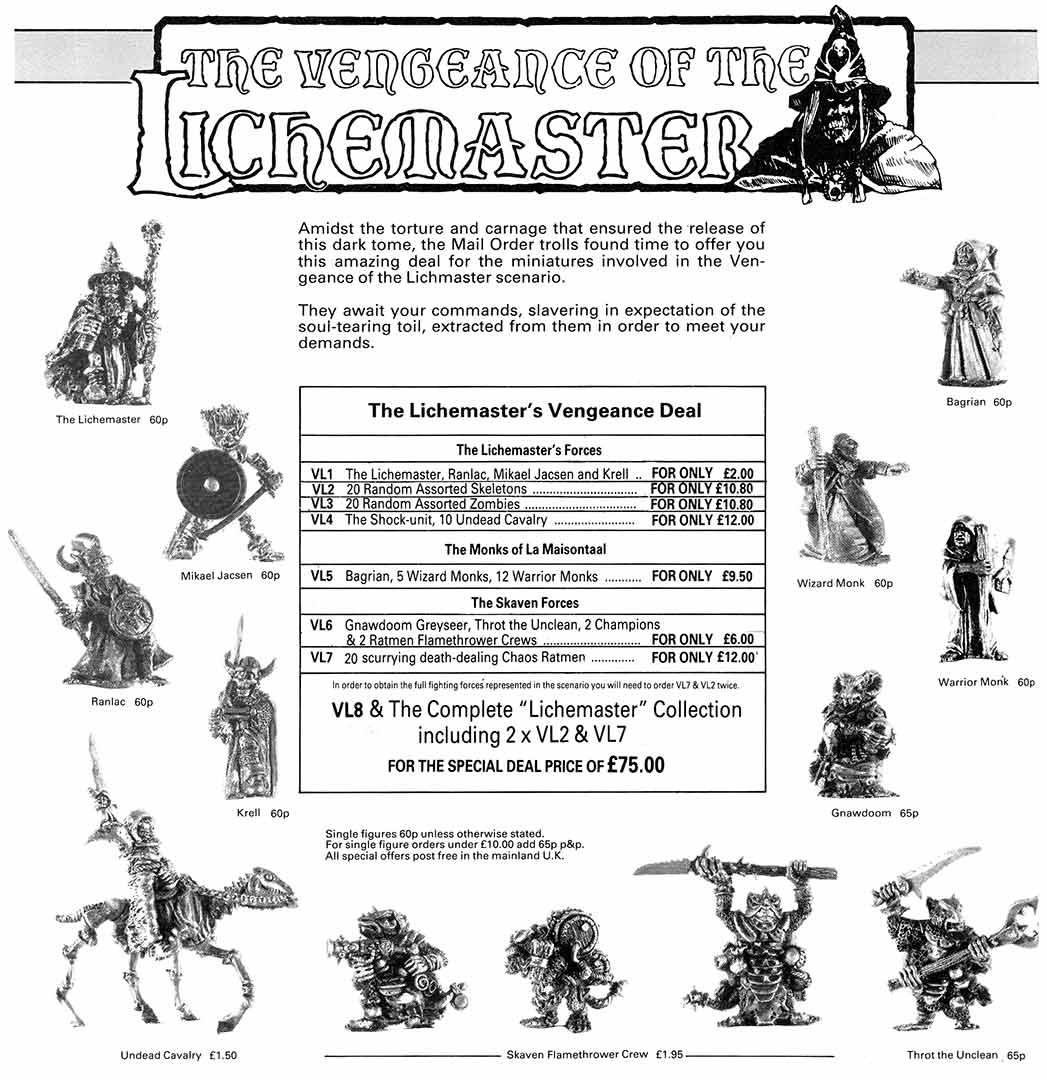
Last week we looked at the Wizard Monks of La Maisontaal, the monastery dedicated to Taal that lies at the heart of the Vengeance of the Lichemaster scenario from 1986. In addition to his five magic users, Bagrian the Abbot also has a complement of twelve Warrior Monks. The scenario (by Rick Priestly) tells us that "The warrior monks of Taal are young monks not yet judged able to progress to magical tuition. However, they are by no means ordinary men. Years of mental preparation and study on the martial arts has given them considerable fighting abilities as well as unusual mental fortitude."


As with the Wizard Monks, the Warrior Monks provides a great excuse to delve into Citadel's extensive back-catalog of Clerics that flourished from 1983-1986.


First up is the C03 Cleric "Ivory Temple" sculpted by Bob Naismith in 1985. He's distinctive for his detailed facial expression and the gorgeous temple carved into his shield. This is also the only miniature specifically portrayed as a Warrior Monk in the advert for The Vengeance of the Lichemaster, which means that he can be hotly demanded on eBay.


In painting his shield (which seems to represent La Maisontaal itself), I kept thinking of the religious art at my local gallery, the Art Gallery of Ontario. Specifically, I was drawn to the brilliant gold skies in works like "The Vision of St. Benedict: by Giovanni del Biondo (1330-1398):


I also wanted to try to conjure up a mystical sense of an otherworldly place. Luckily the technique is pretty simple: a nice smooth coat of gold paint without any highlights or shading as the sky, contrasted to an earthy foreground.


Above we have the "monk" from the C46 Townsfolk range sculpted by Trish Morrison in 1985. Do you love or hate Trish's work? This sculpt certainly bears her stamp: the malformed face (in this case, no chin, wide eyes and huge ears) plus disproportionate man-hands. And yet, for all its seeming ineptness, her work captures the same charming ugliness that we see in the peasant faces of Bruegel or Bosch. For instance, here's a detail from Bruegel the Elder's "Peasant Wedding" (1567):


Say what you will about Trish's sculpting style, but it's distinctive. And that counts for a lot in my book.


Here is the "Friar" from the C03 Cleric released by Citadel in 1983, sculptor unknown (although I suspect it's Bob Naismith). I love the simplicity of these early solid-base sculpts. There aren't so many buckles, scabbards, pouches, straps, skulls jewels or scrolls, leaving greater focus on the face.


This is the C03 Cleric "Warrior Monk" from 1983. He shows off the classic Citadel sense of humour: a round, friendly face leaning forward in front, belied by a club clutched in the rear. Of course, there is good historical evidence for this sort of pose:


The above illumination is from MS Bodley 265 (14th century) in the Bodleian Library (Browse the entire manuscript here and hat tip to the Minnesotastan for the image).


Above is the C03 Cleric "Black Brotherhood" sculpted by Bob Naismith in 1985. Compare this with the last couple monks and you can see the way that Citadel miniatures grew more detailed from '83 to '85. But their poses also grew more dynamic (Although it's unclear why he's raising his shield like that. Perhaps he senses that somebody is about to throw a vase at him from somewhere behind him?)


As our last miniature today, here's the C03 Cleric "Red Robe"sculpted by Bob Naismith in 1985. This Cleric adventurer has a great sense of forward momentum, complemented by a determined face.


Stay tuned for next week, when we'll look at the rest of the Warrior Monks, including their leader, standard bearer and musician.

Thursday, October 19, 2017

Vengeance of the Lichemaster: Wizard Monks and the Mechanical Warrior


The next chapter in our tour through The Vengeance of the Lichemaster (1986) is a visit to the wizard monks of La Maisontaal. The Warhammer campaign written by Rick Priestly tells us that in addition to the Abbot Bagrian (featured last week), the monastery has five power magic users. 

Anyone looking to conjure up some Citadel wizards for an old-school scenario is spoiled for choice. One of the first, best and most under-used ranges in Citadel's early "C-Series" were the ranges of miniatures dedicated to various AD&D character classes: C03 clerics, C04 thieves, C07 rangers and (of course) C02 wizards. Most of the miniatures in these ranges were the work of the incomparable Bob Naismith, who has perhaps the most versatility of any of Citadel's classic sculptors. Unfortunately, as Warhammer 3rd edition (1987) shifted away from role-playing to focus exclusively on battles regulated by Warhammer Armies (1988), this deep fund of individualized characters was shunted to the side.

Well, Venegeance of the Lichemaster gave me an excuse to trawl through my old collection of wizards and pick some of my favourites for La Maisontaal.


First up is the C02 Wizard "Hansat" (aka "Mergrey Calchoner" from The Tragedy of McDeath) sculpted in 1985 by Aly Morrison. He's the only miniature specifically indicated as a wizard-monk for The Vengeance of the Lichemaster by the advert in the Spring Journal 86. I love this figure -- his bald head, unassuming dress and air of authority always reminded me of "Ogion the Silent", the wise mage from Ursula Le Guin's A Wizard of Earthsea (1968).


This is the C02 Wizard "Casslin Spellweaver" sculpted by Aly Morrison (1987). With this miniature, you can see the colour scheme I applied for these wizard monks. Vengeance of the Lichemaster tells us that mages of the god Taal generally wear red, so I made this the primary colour. But I also wanted to connect these wizard-monks to the monk side of the equation, so I painted their cowls/hoods in the homespun brown that I used for the habits of the regular brothers (which I'll show off in my next post).


Here is the C02 Wizard "Skrole" released in 1987 and sculpted (I presume) by Aly Morrison (Although I can't find any direct attribution to Morrison, the face and robes are distinctively in his style). This miniature is the perfect encapsulation of the harried apprentice. Originally, I wanted to paint him as somewhat fresh-faced, but sometimes the brush has a will of its own, and he came out as something more sinister. The circles under his eyes suggest that he has been spending some late nights reading books that ought not to be read.


This is the C02 Wizard "Spell Master" released in 1985. I'm not sure who the sculptor is, but I would guess either Aly Morrison or Bob Naismith. In any case, this seemingly simple figure has some charming touches. I love the way he arches backward from his hips, giving even more power to his pointing hand.


Now this miniature is a bit of a mystery. I call him "Le Grand Sorcier" for lack of any official designation. He appeared under that name in Dave Andrew's iconic Bretonnian Army on page 62 of Warhammer Armies (1988). And his tab indicates that he's a Citadel sculpt. But I have been completely unable to trace the miniature to any catalog or listing on The Stuff of Legends. If you have any insights about this miniature's provenance or sculptor, please leave a comment!

By the way, on this miniature, you can clearly make out the crescent moon medallion that I tried to incorporate into all these wizard monks (including Bagrian) in order to tie them all together and associate them with the nature god Taal.

The final elements for the wizard monks of La Maisontaal are their magical treasures: the Mechanical Warrior that the abbot has constructed and the Black Ark of the Covenant that he stole in order to give life to his metal man. Unfortunately, the Citadel design team did not designate special miniatures for this either, which was a sadly missed opportunity to do something fun. However, if you look carefully at the sheet of paper counters supplied for Vengeance of the Lichemaster, however, you can see what the illustrator Tony Ackland had in mind:


Yes, the Mechanical Warrior is quite Dalek-like, although the gunstick (aka Dalek machine gun) seems to be missing.


In any case, I decided to go my own way for the Mechanical Warrior and used a converted version of "Jackbot B", which was one of the Bots released by Citadel in 1986 for the Paranoia role-playing game. This design seemed to be both brawny and goofy, which is more or less what the situation calls for.


And to portray the Black Ark of the Convenant, the casket of warpstone that can activate the Mechanical Warrior, I chose one of Citadel's C39 Treasure Chests (1984). I love this range because they are the only miniatures that I'm aware of that were sculpted by game designer and scribe Rick Priestly. With its hawk heads (or are they hieracosphinxes?), this particular chest reminded me of the cherubim on biblical ark. 

Rick Priestly as a scribe from Warhammer Fantasy Roleplay (1986)

Thursday, October 5, 2017

Vengeance of the Lichemaster: Bagrian the Master of La Maisontaal


The Vengeance of the Lichemaster from 1986 is a battle with everything: undead cavalry,  kung-fu monks, an Ark of the Covenant, the first appearance of the Skaven in print and a Dalek. It requires lots of rare Citadel miniatures, and I've just finished painting all of them. I'm happy to share the results with you over the next few weeks.


The Vengeance of the Lichemaster is the sequel to the three-battle campaign The Terror of the Lichemaster (1986) which was released by Games Workshop in a boxed set for Warhammer Fantasy Battle 2nd edition. Both were written by Rick Priestly. However, Vengeance wasn't a stand alone product but was published in that fabulous magazine, The Citadel Journal Spring 86. Vengeance provides one final battle for the Lichemaster Heinrich Kemler. But unlike Terror, which was a straightforward contest between the evil necromancer and the innocent denizens of the Frugelhorn Valley, Vengeance is a crazy three-way melee. The forces of the undead face off against a power hungry abbot and his magical monks, and both have to contend with a rampaging warband of chaos ratmen. Like any other ménage à trois, it will take up a whole afternoon and involve a lot of mess.

The scenario begins with the premise that the Heinrich Kemler successfully overcame the forces of goodness from Terror. He emerges from the Frugelhorn Valley with his undead army swollen with the freshly killed villagers and his magic powers surging to new heights. The next obstacle in his way is La Maisontaal, a monastery dedicated to the nature god Taal. Attacking this temple is especially important to the Kemler because its abbot, Bagrian, was once his collaborator back in the days when Kemler was a world-renowned master of the magical arts. However, when Kemler was branded as a heretic, weakened by his enemies and hunted across the Old World, Bagrian turned his back on him. Now that Kemler has recouped his strength, he is eager for vengeance.


Bagrian steals the Black Ark illustrated by Tony Ackland
However, when Kemler arrives at La Maisontaal, a surprise awaits him. The monastery is already aflame. A small army of Skaven have been attacking the compound all day long and are now gathering their forces for one last push. They are there because Bagrian stole something from them. He had sneaked into their hidden city, Skavenblight, and made off with one of their most holy artifacts, the Black Ark of the Covenant. After this outrage, armies of chaos ratmen had been fanning out across the land searching for the culprit. Now, finally, a Skaven wizard named Gnawdoom has pinpointed the location of the Ark with his magic seerstone. He will reclaim the Ark or die trying!

At the centre of this drama is the enigmatic figure of the abbot Bagrian. At first glance, we expect the monkish Bagrian to be a "good guy". However, on closer examination, he turns into a more ambiguous figure... a sort of mad scientist in the mold of Victor Frankenstein, C.A. Rotwang or Dr. No. And like the latter two gentlemen, he's suffered horrible injuries from his experiments leaving him with mechanical limbs (in Bagrian's case, he has a silver hand and metal plates over half of his body). And like any mad scientist worth his salt, Bagrian is obsessed with creating new life. 


In Bagrian's case, this is "the Mechanical Warrior", a metal golem with inhuman strength. Unfortunately, until now Bagrian has been unable to bring this metal shell to life. But that's why he stole the Black Ark of Skavenblight. This is "a huge chunk of solid warp-stone, pure chaos stuff that burns fiercely with its own black light" that's kept for safekeeping in a magic chest. Bagrian has been unable to open this magic chest. And he does not know that his assailant, the Skaven wizard Gnawdoom, is carrying the only key.


A detail from "Bagrian's Doom" by John Blanche, the cover art for The Citadel Journal 86

If Gnawdoom succeeds in retrieving the chest and revealing the Ark, all hell will break loose. Black lightening will flash from the artefact, incinerating his enemies. But a bolt of this energy may also strike the Mechanical Warrior... At that point, I think we can all hear Bagrian exclaim, "It's alive! IT'S ALIVE!"

Here's my rendition of Bagrian:


His miniature was originally named "Seerstone" and was part of Citadel's C02 Wizards range sculpted in 1985 by Aly Morrison. I love his outstretched hand with its mechanical hand, and the imperious expression on his face. This is Aly Morrison at his best! You can also check out some other gorgeous renditions of Bagrian by Nico and Dral.

Stay tuned and in a few days we'll meet Bagrian's wizard companions and his Mechanical Warrior, plus we'll examine one of the few miniatures ever sculpted by Rick Priestly.


 And you can see all of the miniatures from Terror of the Lichemaster here!


Friday, September 15, 2017

Classic Monsters from Otherworld Miniatures


A couple weeks ago I discovered lead rot on some classic Citadel hobgoblins stored in my attic. I've euthanized pets with less emotion than the pain involved in throwing out these hideously maimed miniatures. Never again, I vowed to myself. As a result, my energies have lately been spent on prepping and priming all my really old miniatures in hopes of protecting them against corrosion. And it's not fun to share pictures of primed miniatures. So in the meantime, I dug out some Otherworld miniatures that I painted a few years ago but never got around to posting. I hope you enjoy them: while you browse, I've got some spray-painting to do.

First up, we have the magnificent Otyugh, which is described by Gary Gygax in the Monster Manual (1979) as a garbage dweller, "eating dung, offal and carrion, as well as fresh meat when it is available" and "living in their piles of rubbish and droppings." Sculptor John Pickford went beyond your run-of-the-mill abomination and gave us a true horror: an anus dentatus. 


Otherworld Miniatures is a direct spiritual heir to the Citadel Miniatures of the golden age in the mid-1980's. Indeed, Otherworld's founder, Richard Scott, is the proud owner of the definitive collection of Citadel's short-lived but opulent range of licensed AD&D miniatures. In starting Otherworld in 2006, he created a line of miniatures that is clearly inspired by that early Citadel aesthetic: simple designs, rounded features, expressive faces, and a emphasis on gesture and character rather than action or violence. 

You see all these wonderful traits on display in the Evil High Priest, sculpted by Citadel alumnus Kev "Goblin Master" Adams:


Richard Scott himself has pointed out that the original Citadel AD&D range had a "definite 'UK flavour', featuring creatures from TSR UK's Fiend Folio [1981] such as Githyanki, Norkers, Meazels and Xvarts." This British influence continues in Otherworld's own offerings. Here are the delightful Meazels sculpted by Kev Adams:


One of the other things I like about Otherworld is that it covers many basic monsters that unglamorously populate every low-level dungeon such as giant ticks, violet fungi and stirges. For instance, here are Kev Adams' Fire Beetles:


Of course, sometimes it's nice to colour outside the lines. When it came to that most classic of monsters, the Gargoyle, I decided to try something a little different... I wanted to create a molten monster of hot, cracking stone and seeping lava. So here is one of the Otherworld Gargoyles sculpted by Paul Muller:


Hmmm. Perhaps that's no so successful. So for the second Gargoyle, and my last Otherworld miniature, I went back to basics:


What a great pose!

Let me know in the comments if you've painted any Otherworld Miniatures and if you like them as much as I do. Cheers!


Friday, September 1, 2017

The Evil, the Bad and the Ugly... An Evil Campaign for Dungeons and Dragons


Inexplicably, last week's post on the 1984 controversy about running an evil campaign in AD&D turned out to be the most popular post I've ever written. Which is funny, because I wrote it merely as a preamble to my real topic... which is the evil campaign that some friends of mine and I played a couple years ago. Although our group rotates the role of Dungeon Master, it usually falls to me to write the introduction to every campaign... so without further ado, here is my introduction to our Very Evil Campaign, aka Down and Out with the Great Hood:


The Evil, the Bad and the Ugly

It is an evil time for those who love evil. How promising it had all appeared just a few months ago. The Land of the Flanaess was ignited in a war of shocking ferocity and bloodshed. The Great Kingdom, a powerful but decadent empire, had mustered her armies and attacked the civilized nations all around her. And that wasn't all: orcs flooded down the mountains in the South and barbarians swarmed from the North. Meanwhile, Iuz the Old (an evil dictator and so-called demigod) summoned a massive demon host with which to attack his enemies. Not that you were rooting for Iuz. As far as you are concerned, Iuz is nothing but an amateur.


Iuz the Old from Dragon #67
But it was a promising war nonetheless – Nyrond, the Kingdom that you inhabit, was devastated and then impoverished by the war against the Great Kingdom, and then riven in pieces by a costly civil war that followed on its heels. Banditry, starvation and lawlessness became the rule of the day. During this mayhem, the Great Hood saw his chance!

For that is the name of your Master, the Great Hood. He tells you that once he was a great lord in the court of the arch-lich Vecna. In ancient times, he had sat in council with the very Princes of Hell as Vecna laid his plans for the domination of all of Aerdy. The power of Vecna in those days was unimaginable – today’s armies are like children’s toys by comparison. And the Great Hood had a large share of this power. Very large. Vecna had promised him a vast dominion since Vecna saw in him a power, an intelligence and a propensity of evil that nearly rivalled Vecna’s own. In fact, it would be somewhat inaccurate to say that the Great Hood was Vecna’s subordinate – even Vecna realized that the Great Hood was more like a co-ruler since his necromantic powers were so great.
At that time, Iuz was just a boot-polisher in Vecna’s retinue. Did Vecna and the Hood mock Iuz? Only insofar that they noticed him, which of course they did not, since he was an inconsequential nobody.


Vecna the Lich
But all this ancient glory came to naught. Vecna was betrayed by his Sergeant-at-Arms, the vampire Kas. Some have said that Kas was Vecna’s second in command, but that is a gross exaggeration – the Great Hood occupied that position. In fact, Vecna told the Great Hood that he was to be Vecna’s only heir. If no one else knew about this designation, why should they? It was between Vecna and the Hood. And anyway, Vecna was called the God of Secrets for good reason – he didn’t throw that kind of information around. Which is to say: Kas was merely a foot soldier, a stupid drudge who betrayed Vecna and slew him with a black vorpal sword. This was a grievous betrayal, but it was followed by an even greater treachery – the Great Hood should have taken Vecna’s place, but instead he was robbed of his inheritance by a band of parasites like Iuz, Kas and Demogorgon. They cheated him, stole his power and deprived him of his station. Even thinking about it makes you angry.

Following the death of Vecna, the Great Hood spent long centuries in the dark places of the earth, quietly assembling the forces he would need to revenge himself on all those who injured him. During this time he transitioned from being a living necromancer to an undead lich and finally to a demilich, which is to say, to an incorporeal spirit bound to a few decayed bodily remains. In the Great Hood’s case, these remains are his left femur and his jawbone, which are generally kept for safekeeping in a terracotta urn. Despite all, his intellect was great as ever and his plans were of such excruciating brilliance that they could not fail to succeed. Except that time and time again his henchmen failed him through incompetence and cowardice. Is it any surprise that his name fell into obscurity and his most capable followers gradually abandoned him? What a miserable chronicle of failure the last few hundred years had become. Finally, the Great Hood was driven like a rat from one place to another, sometimes pursued by servants of the good gods, other times evicted from his lair by more powerful monsters. 


Kas the Betrayer
Thirty years ago, the Great Hood took a small keep in the hills of Nyrond as his abode. His brilliance in selecting this location was apparent after thirty years of solitude and privation, when Nyrond was plunged into the above noted struggle with the Great Kingdom. As the forces of order and justice disappeared from the countryside, the Great Hood saw the opportunity to reverse his fortunes. Raising up a mighty platoon of skeletons, he gradually began to accumulate greater wealth through extortion and banditry, until he was able to fortify his lair and assemble a formidable band of followers. That was when you came into his service.

What heady times! The King’s soldiers were nowhere to be seen. Most men of fighting age were warring in far distant battlefields. Only the old men and children were left, and they knew better than to take on the Great Hood. The Halfling settlement to the south of his lair (“the Canton”) was almost entirely subdued, as was the nearby town of Yort. The Great Hood’s keep (“the Mournhold”) was populated with monsters from far and wide, a menagerie whose diversity was a point of special pride for all of you. Were there not kobolds, umber hulks, black puddings and undead all cohabiting under the Great Hood’s awful banner? You all felt important and powerful, and the Great Hood made it known that soon we could begin his Ultimate Plan – the construction of a specially designed temple whose very architecture would channel unimaginable power into the Great Hood, finally restoring him to his true power.

That’s when things went pear shaped. The war against the Great Kingdom (called the “Greyhawk War” because the peace treaty was signed in the free city of Greyhawk) ended, and Nyrond’s civil war concluded in favour of the Good King Lynwerd. Rumour has even come to you that Iuz himself was destroyed with the help of a young band of heroes. A new dawn was coming. A bright, horrible dawn.


The Great Hood in all his glory
Although Nyrond was still impoverished, road-wardens and militiamen once again began to patrol the byways and towns. The townsmen of Yort began to mutter about a return of the King’s justice, and soon even the Halflings began to sass you whenever you rode through their land. As the Great Hood began to gather his forces for one final, decisive attack on Yort, he was ambushed in his own keep by a band of adventurers. The struggle was terrifying and bloody, with the band of warriors moving from one room to the next, inexorably slaying the inhabitants and searching them for treasure. The pit traps, the secret doors, the scary magic-mouths – all were no use.  They even slew Manty, your special manticore friend. The only reprieve from this horrible assault came when the adventurers would hunker down in one room to rest for eight hours, heal and re-memorize their spells.  

Finally, the team of do-gooders arrived in the Great Hood’s throne room: the Paladin Raymond Snowcape; Valence, the Priest of Heironymous; and Mandrake Mooncup, the Halfling Fighter. Your surrender was swift and total. In your mad rush to throw down your arms and beg for mercy, you are unsure what happened to the urn containing the Great Hood...


Design notes: This campaign occurs in the aftermath of The Greyhawk Wars. I chose the Greyhawk campaign setting because I wanted a world with lots of magic and an old-school feeling. It also let me freely draw on some iconic emblems of AD&D, like the Eye of Vecna and the Sword of Kas. 
As many have pointed out before, the problem with evil campaigns in general is that the parties are generally torn apart by the centrifugal power of selfishness and cruelty. In order to overcome this, we devised the idea that the characters are loyal lackeys of a Dark Lord in the mold of a Sauron or Vecna. This should keep them (somewhat) unified. However, the danger with having a powerful boss is that the characters may learn to depend upon his greater knowledge or power to extricate them from the perils of the campaign. In order to avoid this, we made the Great Hood a deeply weakened Dark Lord. He barely has enough power to manifest a spectral presence, let alone save the characters' bacon in a fight. 
Being servants to a useless Dark Lord has a lot of comic potential (not unlike the Dungeon Keeper games for the PC). And indeed, humour was a big part of our campaign, and kept our evil game from ever getting too dark or distasteful. The Great Hood himself was inspired as much by Sauron as by Jacob Two-Two Meets the Hooded Fang. 
Our first adventure involved the characters escaping from the prison house at Yort and re-uniting with the Great Hood (i.e. an urn with the Great Hood's left femur and jawbone) in his hiding spot in the potato cellar of a local inn. It was the beginning of a long and hilarious set of adventures. I hope that perhaps this write-up inspires you to your own expedition into the heart of darkness...


Friday, August 18, 2017

Don't You Dare Play an Evil Character in Advanced Dungeons and Dragons


A controversy charred the pages of Dragon Magazine in the summer of 1984. In issue #89, author and contributing editor Katharine Kerr wrote a long opinion piece on the evil of running "evil campaigns" in fantasy role-playing games. Kerr wrote that "there are too many arguments against playing evil campaigns for me to review all of them here" and so she focused on the psychological harm that these games inflict on their participants: "I maintain that spending all that time pretending to be evil is dangerous to the players themselves." Her point was that playing a villain warps your personality by normalizing violent behaviour and eroding your natural sense of compassion. She even included a story about "a gamer I'll call Bob" who embarked on an evil campaign that left him and his friends "emotionally and morally calloused".


Author Katharine Kerr
This touched a nerve. In subsequent issues, Kerr's polemic against evil campaigns was strenuously debated in letters and articles. One letter began "I am sure that I am not alone when I say that Katharine Kerr's article about evil PCs left me both disturbed and contemplative. Her analysis truly frightened me into thinking that players who run evil characters have some serious emotional problems." Other letters were defensive and peevish. Some justified evil campaigns on the basis of psychology (they are an "outlet" for negative emotions) or realism (resort to harsh tactics is one well trodden path to power). In issue #91, one astute letter writer noted that even in a campaign with all good characters, one person is still obligated to take the role of the villain, namely the DM. This author goes one to ask if "the DM heading for the psychiatrist's couch?"

This debate kindled a broader discussion about alignment in Advanced Dungeons and Dragons. AD&D, of course, strictly categorized all living beings into one of nine alignments based on the permutations of Good, Evil and Neutral on one axis, versus Lawful, Chaotic and Neutral on the other axis. Thus, in issue #93, one correspondent posed a series of questions about whether this alignment system is based on a medieval European morality or a "20th century, Judeo-Christian, American morality". Actually, that's rather a good question. Dragon Magazine answered with articles on "The Neutral Point of View" in Issue #99 and a plea for a less black-and-white approach to alignment in "For King and Country" in Issue #101.


What to make of this brouhaha? Well, let me start by saying that I've got a lot of time for Katharine Kerr. Besides being an accomplished author, she wrote one of my favourite magazine articles of all time, a thoughtful breakdown of medieval army logistics called "An Army Travels on its Stomach" (in Dragon #94). So I don't want to dismiss this dispute as a simple matter of hyper-morality. Rather, I think Kerr's article and the aftermath were the product of a special point in time.

The most striking part of the whole debate is how seriously people took AD&D. It seems that in the 1980's, the imaginary world of the role-playing game cut much closer to the bone than it does in our more jaded and ironic present. Reading Kerr's article and all the responding letters conveys an impression that the gaming sessions of the mid-1980's were viscerally linked to one's personality and outlook on life. What happened on the gaming table mattered, and said something about you as a person. In this sense, there was a thinner barrier between the realm of fantasy and the world of reality. (Incidentally, the muddled boundaries between the real world and the imaginative realm of 1980's D&D players is something captured well in the period piece Stranger Things.)

One thing that lent spice to the debate about evilness was the moral panic that engulfed Dungeons and Dragons during this time. I still remember the mistrust with which teachers and administrators at my school regarded D&D in the wake of movies like Mazes and Monsters (1982) or 60 Minutes special in 1985. While anyone with a shred of familiarity with AD&D knew that it wasn't a portal to demonic possession or mental illness, the controversy around the game jangled everyone. Thus, a conversation about evil PCs had higher stakes in 1984 that it does now. In fact, I don't think that sense of heightened concern wasn't as bad even a couple years before --  for example, in 1982, Dragon published a playful article about playing an evil character and there was no blow-back or debate ("How to Have a Good Time Being Evil" by Roger E. Moore in Issue #45).


It's also important to put the "evil campaign" dispute in perspective. At the same time that Kerr and company were fighting over morality and psychological health, an equally acerbic debate was going on in Dragon Magazine... about how to properly calculate falling damage in accordance with Newtonian physics. This argument also spanned several issues and engendered withering criticism. (My favourite line: "While I admire the detail of research and reasoning in Stephen Innis' article, I think he's made an error by comparing the proportionate weight of a dwarf expanded to six-foot stature to that of a six-foot human.") Which is to say, flame wars were a part of gaming culture long before the rise of the internet.

The only thing that truly troubles me about the 1984 controversy is that one one mentioned the most important and obvious part of evil characters: however evil they may be, they never actually see themselves on the wrong side.

I bring all this up for two reasons. First, I love travelling back in time and seeing how attitudes towards our hobby have changed, even within my lifetime. And second, I want to introduce you to my own evil campaign...  

In the meantime, do you think there is any problem with playing evil characters? Does that question seem too naive to even ask it?

Thursday, August 10, 2017

Guest Post: Arbaal the Undefeated... a stopover in Oldenhammer


My friend Travis, proprietor of Hot Dice Miniatures and miniature painter extraordinaire, has written a guest post for Oldenhammer in Toronto. I'm happy to be able to showcase his superb work...

Matthew has graciously allowed me to show off some of my Old Hammer here on his blog. Unfortunately this means that you as the reader can expect none of the charm, and about half of the wit usually found here. For this occasion I have dug out something from my closet that is extra special in the market of old Games-Workshop pieces.

The story about how I first came to own this particular miniature begins as it always does: in a game store. I was out of town playing in a Kings of War Tournament when the game store's dusty corners revealed an old gem to me. "Champions of Chaos" bore a piece of masking tape marked in red sharpie: $5.

One of the showcased figures began to jump out at me after some trips to the porcelain throne with the old paperback. Near the back of my bookshelf is where this tome would end up after its newness had worn off. Some time later I spotted this miniature that looked so familiar on Ebay for an absurd $200 CAD. 


I pulled out the Champions of Chaos book to see if I could source the miniature’s back-story, points cost and so forth! 


“In the name of Khorne, Arbaal the Undefeated challenges a Vampire Lord to single combat.” 

Low and behold he was in there...


“Thousands have felt his axe blade at their necks and now their white skulls lie at the feet of Khorne. At the city of Praag in the northlands, Arbaal led a hundred Daemons in the assault on its boundaries. It was Arbaal who finally breached the gates of the city and ended the siege. Legends claim that Arbaal slew a thousand warriors that day.”

Arbaal comes in weighing at 570pts, and has a Weapon Skill rating of 9. Every turn he rolls 2D6 to generate his number of melee attacks, and turns into a Chaos Spawn when he fails Leadership tests!


No more than two weeks after the Ebay spotting I found a listing for him on the local Kijiji for a measly $20 CAD! I couldn’t believe my eyes. Money was exchanged and now I can bring you the above photo of his bare metal beauty.


It turns out that his banner is actually a sticker à la the 90’s. I was both intrigued and dismayed to realize that this wasn’t the type of transfer that I’ve grown accustomed to over many years of purchasing GW kits.


The figure went together beautifully 
using Super T Hot Stuff, no pinning required. I couldn’t help but notice how cool the box he came in was while I was putting him together.

I’ve just finished painting some modern GW plastics and 5 crisp Infinity sculpts. I’m not sure why exactly but it felt as if this old model was fighting against every inch of the paint job. I struggled with the rounded edges and blown out details on the rider.

Not being a huge fan of the paintjob exhibited on the box art I decided to attempt a decidedly more red & bronze scheme.


There are things about the final paint job that I like, and some that leave me a little disappointed. The things that I like include the horns, the axe’s blade and the glove’s fur. What surprised me was how good the sticker-banner looks when compared with regular hard plastic banners. 


The pooch upon which Arbaal rides went through multiple colour changes, and ended up being one of the things about the paint job which left me disappointed. Perhaps it is the way the horns don’t contrast with the skin, or the general messiness of the skin details. 


A Slaanesh Champion challenges Khorne’s most devoted servant to a throw-down.

I’ve been enjoying messing around with my minis in Photoshop using silly .PNG pictures lately. If you enjoyed this diarized project then perhaps you might enjoy a peak at my blog. I don’t always paint Old Hammer stuff; usually just whatever shiny manages to grab my goldfish-like attention span. https://www.hotdiceminiatures.com/hobby-blog/

Thanks to Matthew for allowing me share with you all. Paint criticisms & critiques are appreciated.​