Friday, August 28, 2015

Painting Pain: Darth Vader without the helmet


It's amazing what you can do with an X-Acto Knife and an unshakable faith in the Dark Side of the Force. Here's my most recent miniature conversion for Imperial Assault, the Star Wars skirmish game from Fantasy Flight: Darth Vader without his helmet. 


If there's anything scarier than Darth Vader in his mask, it's Darth Vader with the top down: the bruised eyes, the long unhealed wounds, and the skin pale as a moonscape. There is no better subject if you want a miniature as a portrait of a person in pain.


Darth Vader's wounds
The conversion was dead simple: I sliced off Darth's helmet just above the base of his triangular mouthpiece, and then lightly sanded the surface until it was even. Then I hunted around for a replacement head, eventually settling on a Warhammer 40K Space Marine Terminator Lord. This Terminator was appropriately bald and scowley. I cut off the bottom of the head so that when it was in place, it would give the impression of Vader's head sunk into the high collar of his suit.

The fun part was the painting. Vader's ruined face gave me a lot of room to mess around, especially all his vivid scars. I'm pleased with the way it turned out, insofar that his expression seems to change depending on his facing. Sometimes he looks evil and sullen, sometimes he looks evil and crafty, and sometimes he just looks plain evil.

Well, Fantasy Flight just released Twin Shadows, a new expansion for Imperial Assault featuring a Boba Fett. So stay tuned for more painted Star Wars action soon...


I hope you join the Dark Side soon.


Saturday, August 22, 2015

Reading along with the Lord of the Rings: A Conspiracy Unmasked


Chapter 5 of The Fellowship of the Ring

In A Conspiracy Unmasked Tolkien reveals that Frodo's friends have been watching his strange doings with the wizard Gandalf. Merry, Pippin, Fredgar and Samwise, realizing that Frodo is burdened with a dangerous task, have decided that he will not face it alone. As Merry tells Frodo:
'You can trust us to stick to you through thick and thin -- to the bitter end. And you can trust us to keep any secret of yours  --closer than you keep it yourself. But you cannot trust us to let you face trouble alone, and go off without a word. We are your friends, Frodo. Anyway: there it is. We know most of what Gandalf has told you. We know a good deal about the Ring. We are horribly afraid -- but we are coming with you: or following you like hounds.'
Here lies the emotional core of the first book of the trilogy, if not the entire trilogy itself: the forging of a fellowship in bonds of trust and mutual help. The first book is well named; as a reader, I care more about this fellowship than I do about any individual member of it. Frodo, Sam (and eventually Gandalf or Aragorn) are all sympathetic, but none of them are as important as the relationship that binds them. The fellowship holds a promise to both characters and readers alike: the notion that friendships can last, that even the worst troubles are best shared, and that we don't need to face the dark alone.

The tragedy, of course, revealed to any reader who bothers to scan the table of contents, is that the last chapter in this book is called The Breaking of the Fellowship. This bond of friendship will snap, and it will do so in ways precisely foretold in Chapter 5. Just as Frodo is depressed now at the thought of deceiving his friends and escaping the Shire alone, at the end of the book, he will make the gloomy decision that he must slip away by himself, as the rest of the fellowship founders around him. The remainder of the trilogy is as much a story about the ultimate reunion of the four hobbit friends as it is about the destruction of the One Ring. But I'm getting ahead of myself...

Before leaving Chapter 5, I'd like to take a closer look at the odd man out in the fellowship of hobbit friends: Samwise Gamgee. Many commentators on The Lord of the Rings, including Tolkien himself, suggest that Sam will become the central character in the trilogy -- the character who best exemplifies Tolkien's recurrent theme:
The place in 'world-politics' of the unforeseen and unforeseeable acts of will, and deeds of virtue of the apparently small, ungreat, forgotten in the places of the Wise and Great (good as well as evil)... without the simple and ordinary the noble and heroic is meaningless. (Letter #131 to Milton Waldman, 1951)
And of course Sam's loyalty to Frodo is the one fragment of the fellowship that will remain intact throughout the whole War of the Ring. But at this point in the story, it's important to understand Sam's status. He is not Frodo's friend -- he is Frodo's servant.

Sam and his father "tend garden" for Frodo, and we're told that when Frodo pretended to move to Crickhollow, the pretense was that Sam was going too so that he could "do for Mr. Frodo and look after his bit of garden". It's easy to view Sam as naturally humble, long-suffering and faithful -- but it's important to realize that these traits are not unique to Sam. They are the typical qualities expected of a servant in the heyday of the English class system.


Samwise by Citadel Miniatures
In the wake of Downton Abbey and its ilk, there has been an uptick in interest in the culture of the servant class. Most of my knowledge on this topic derives from P.G. Wodehouse (his 1915 novel Something Fresh is surprisingly good at explaining the social hierarchy among the servants in a big house). For the purposes of The Lord of the Rings, one of the most revealing things to keep in mind is that servants were not permitted to offer their opinions to their betters. Servants (like Victorian children) were to be seen and not heard.

Understanding this fact throws a new light on Sam. In the early stages of the hobbits' voyage, Sam's voice is heard only in its absence. This silence is easy to miss if you're not looking for it. Whereas Pippin or Merry are happy to complain, tease and chat with Frodo, Sam is usually silent. He doesn't sing in the bath, or scrap over another serving of mushrooms. If he does speak, he prefaces it with "begging your pardon". But this diffidence isn't inherent to Sam; after all, we know his speech changes entirely when speaking to men of his own class (like Sandyman and co. at The Green Dragon) where Sam is opinionated and voluble. 

All of this is to say, as the story progresses, we'll have to watch how Sam grows out of being more than a servant. What does he become?


To read on, here is my commentary on Chapter 6. Or you can find my commentary on Chapter 4 here.

[Image credit: Animation Still by Ralph Bakshi from The Lord of the Rings, 1978]

Monday, August 17, 2015

Painted Talisman Timescape Miniatures


Behold! I just finished painting the complete set of Talisman Timescape miniatures, beautifully sculpted by Trish Morrison and released by Citadel in 1988.


Talisman is a strange board game -- especially the classic version released by Games Workshop in the 1980's (aka the 1st and 2nd editions of Talisman). I don't think I properly understood Talisman until I read an essay written by Umberto Eco (the author of The Name of the Rose) about the movie Casablanca (the 1942 film with Humphrey Bogart). Random? Probably. But stay with me and I promise to post most more pictures of miniatures.

The essay is in Eco's book How to Travel with a Salmon (1995) and is itself titled "Casablanca, or, The Clichés Are Having a Ball". In it, Eco meditates on the incredible success of Casablanca. He writes that this success is surprising since the movie is riddled with hundreds of clichés: the faithful servant, the doomed lover, the redeemed drunkard, the hooker with a heart of gold... Normally, one or two clichés are enough to turn a good work of art into a bad one. But the beauty of Casablanca is that it boasts so many clichés that they reach a critical mass that pushes the movie beyond mere badness, transforming it into something immortal. As Eco writes:
Two cliches make us laugh. A hundred cliches move us. For we sense dimly that the cliches are talking among themselves, and celebrating a reunion. Just as the height of pain may encounter sensual pleasure... so too the height of banality allows us to catch a glimpse of the sublime.
By piling on all these clichés culled from other stories and other movies, Casablanca allows us to relive all these prior experiences at once -- in one delightful, headlong rush.

And this is exactly what Talisman does. The beauty of the game is that it takes every single cliché, trope and archetype from the world of fantasy and crams it into one box. A princess? Check! Gaming against Death? Check! The Black Knight guarding a bridge? A life stealing rune sword? The Holy Grail? A dungeon crawl? A torture chamber?  A bare chested barbarian? Check! Check! Check! The end result is a game that exists in every fantasy world at the same time: partly Tolkien, partly Warhammer, partly historical, partly Moorcock, partly Robert E. Howard and partly the Bros. Grimm. Adding just one or two of these elements would make the game seem a little goofy. But throwing them all together? Well that's an act of genius.

And what I love about Timescape is that the lads at Games Workshop found a way to crank this bastard up to 11. After all, there's no reason to limit oneself to the realm of fantasy. Using the thin premise of an inter-dimensional portal bridging the world of Talisman with the future, Timescape opens up a universe of new possibilities. Why not throw in as many figures from science fiction as possible? Predators, Dune worms, Time-lords, Terminators all appear in thinly disguised forms. Add to them Warhammer 40K characters (Space Marines, Astropaths), generic sci-fi figures from central casting (The Scientist! The Space Pirate!) and (like a maraschino cherry on top) Indiana Jones.


The end result is a hot frothy mess of goodness. The fact that the game is hilariously unbalanced barely matters. Who doesn't want to send a Space Marine rampaging across the fields and woods of a fantasy world, armed with the Holy Lance and accompanied by a Poltergeist? Why not give your Samurai a jet pack and a power glove? Why not give the Chainsaw Warrior one last shot at glory?

H.R. Giger, H.G. Wells and Frank Herbert rock out.

I've certainly enjoyed the latest edition of Talisman published by Fantasy Flight Games. But after playing both the old Talisman and the new a number of times, I've realized that I prefer the original -- mainly because Fantasy Flight's version attempts to unify the look and feel of the game, adding game balance and smoothing out the rough edges so that it presents a somewhat cohesive world. This seems sensible. But screw sensibility with a spoon. It's precisely the chaotic mish-mash that makes Talisman so much fun, especially with the delirium of Timescape in the mix. As Eco would say, all the clichés are having a ball.

Anyway, I hope you enjoy the pics!

Talisman Timescape Archaeologist, Citadel (sculpted by Trish Morrison, 1988)

Talisman Timescape Archaeologist


Talisman Timescape Astronaut, Citadel (sculpted by Trish Morrison, 1988)

Talisman Timescape Astronaut


Talisman Timescape Astropath, Citadel (sculpted by Trish Morrison, 1988)

Talisman Timescape Astropath


Talisman Timescape Chainsaw Warrior, Citadel (sculpted by Trish Morrison, 1988)

Talisman Timescape Chainsaw Warrior


Talisman Timescape Cyborg, Citadel (sculpted by Trish Morrison, 1988)

Talisman Timescape Cyborg


Talisman Timescape Scientist, Citadel (sculpted by Trish Morrison, 1988)

Talisman Timescape Scientist


Talisman Timescape Space Marine, Citadel (sculpted by Trish Morrison, 1988)

Talisman Timescape Space Marine


Talisman Timescape Space Pirate, Citadel (sculpted by Trish Morrison, 1988)

Talisman Timescape Space Pirate

Thanks for looking!


Wednesday, August 12, 2015

Reading along with the Lord of the Rings: A Short Cut to Mushrooms


Chapter 4 of The Fellowship of the Ring

Delay is one of the great themes in The Lord of the Rings. The forces of good are constantly struggling against the consequences of their own procrastination. This idea first comes to the fore in A Short Cut to Mushrooms, as the hobbits race to avoid the Black Riders chasing them across the Shire. After 17 years of delay (in between Chapter 1 and 2), followed by months of further dithering by Gandalf and then Frodo (in Chapter 2 and 3), the hobbits now find they don't have a moment to spare:
When they had struggled to the bottom of the bank, they found a stream running down from the hills behind in a deeply dug bank with steep slippery sides overhung with brambles...
Sam Gamgee looked back. Through an opening in the trees he caught a glimpse of the top of the green bank from which they had climbed down.
‘Look!’ he said, clutching Frodo by the arm. They all looked, and on the edge high above them they saw against the sky a horse standing. Beside it stooped a black figure.
This breathless chase just highlights the foolishness and waste of Frodo's delay throughout the long summer. But he, of course, is not the only one: throughout the book, we will learn that Gondor, Rohan, the Elves and the Ents have all squandered much needed hours and opportunities. The fact that at least some of their peril was avoidable lends to the entire trilogy a sense of tragedy. Although I generally like to avoid overly historical interpretations of Tolkien, I can't help but think that the high cost of delay would be particularly vivid for anyone who lived through the 1930's, when Britain wasted many chances in the lead up and initial stages of World War II.

In any case, I think the theme of delay is a powerful one because it's something that everyone can identify with. Not all of us have been chased by Black Riders, but we've all experienced the awful feeling of rushing to catch up after fruitless procrastination. In other words, this theme is another way that Tolkien bridges the gap between his world of high fantasy and the reader.

There's another aspect of Chapter 4 that I have to comment on: the remarkable character of Farmer Maggot. Just as this chapter introduces the theme of delay, it also introduces a pattern about how the Fellowship will acquire allies -- allies starting with Farmer Maggot. Such allies first appear hostile or at least dangerous (Maggot, for example, used to "beat" a young Frodo Baggins) until they are won over with diplomacy and goodwill. Once befriended, of course, these allies prove invaluable, usually ushering the heroes through their territory and on to the next adventure.

Maggot is one of my favourite characters because Tolkien merely hints at his hidden depths, leaving much to the reader's imagination:
‘Old Maggot is a shrewd fellow,’ said Merry. ‘A lot goes on behind his round face that does not come out in his talk. I’ve heard that he used to go into the Old Forest at one time, and he has the reputation of knowing a good many strange things...’
The best illustration of Maggot's strength of will is the fact that he's the only character in The Lord of the Rings who carries on anything like an actual conversation with a Ringwraith. And not just conversation -- Maggot virtually sasses Sauron's agent of terror when it comes looking for Frodo. The passage (as narrated by Maggot himself) is so rich, I can't help but quote it at length:
‘‘Good-day to you!’’ I says, going out to him. ‘‘This lane don’t lead anywhere, and wherever you may be going, your quickest way will be back to the road.’’ ... The black fellow sat quite still. 
‘ ‘‘I come from yonder,’’ he said, slow and stiff-like, pointing back west, over my fields, if you please. ‘‘Have you seen Baggins?’’ he asked in a queer voice, and bent down towards me. I could not see any face, for his hood fell down so low; and I felt a sort of shiver down my back. But I did not see why he should come riding over my land so bold. 
‘ ‘‘Be off!’’ I said. ‘‘There are no Bagginses here. You’re in the wrong part of the Shire. You had better go back west to Hobbiton – but you can go by road this time.’’ ‘ ‘‘Baggins has left,’’ he answered in a whisper. ‘‘He is coming. He is not far away. I wish to find him. If he passes will you tell me? I will come back with gold.’’  
‘ ‘‘No you won’t,’’ I said. ‘‘You’ll go back where you belong, double quick. I give you one minute before I call all my dogs.’’  
‘He gave a sort of hiss. It might have been laughing, and it might not. Then he spurred his great horse right at me, and I jumped out of the way only just in time. I called the dogs, but he swung off, and rode through the gate and up the lane towards the causeway like a bolt of thunder. What do you think of that?’
Well, I think pretty highly of it myself, Farmer Maggot. It sounds like you might be the bravest character in the whole trilogy.


To read on, here is my commentary on Chapter 5. Or you can find my commentary on Chapter 3 here.


[Image credit: The Brothers Hildebrandt "Farmer Maggot's Hospitality" Acrylic on Board (1978).]

Wednesday, July 29, 2015

Reading along with the Lord of the Rings: Three is Company


Chapter 3 of The Fellowship of the Ring

In Chapter 3, Frodo finally sets out on his quest. But in this Chapter and beyond, Tolkien shows us that this is not just a journey through space. It is also a journey through time... and more specifically, a journey back in time. The fuzzy nature of time is an aspect of The Lord of the Rings that is not often discussed. 


This realization about time travel dawned on me when I read the following passage from Chapter 3, in which Gandalf and Frodo discuss escaping the Shire:
"As for where I am going," said Frodo, "it would be difficult to give that away, for I have no clear idea myself yet."
"Don't be absurd," said Gandalf, "I am not warning you against leaving an address at the post-office! But you are leaving the Shire--and that should not be known, until you are far away." 
The word that arrested my attention here is "post-office". Post-office? Think of what it means to have a post-office (and especially a post-office that offers a mail-forwarding service). It means that there is a high degree of literacy in the Shire (something, in fact, we already know from Chapter 1, where Tolkien mentioned that Bilbo sent out hundreds of invitations and received written replies like Thank you, I shall certainly come.) What does literacy mean? Education. What does education mean? Schools. Schools require prosperity. And prosperity generally requires trade and government.


There are a thousand ways that Tolkien tells us that the Shire is not merely an enclave of subsistence farmers. Rather, it is a civilized, educated and materially complex society, with luxuries that would be unheard of in a medieval setting. Look back again at Chapter 1, at Bilbo's going-away presents to friends and family. These gifts include an umbrella, a set of silver spoons, and a waste-paper basket. Before the Early Modern period, few people owned cutlery, let alone silverware. All Bilbo's presents require sophisticated craftsmanship, but the waste-paper basket is especially remarkable. Until the 19th century, paper, parchment and vellum were rare and expensive commodities in Europe -- so precious that they were reused compulsively. Before the advent of steam-powered paper mills, a waste-paper basket would be like a waste-money basket: a contradiction in terms.

Among the parting gifts, there's also a reference to "a strong red wine from the Southfarthing, and now quite mature, as it had been laid down by Bilbo’s father." This means the bottle in question was at least 75 years old by the time of Bilbo's party, because Bungo Baggins died in 2926. (Incidentally, did you know that Bungo had a brother named Bingo?). In a previous life, I was a wine-critic. So I found Tolkien's throw-away line about this vintage fascinating. Making wine is really hard. For most of the middle ages, wine couldn't keep for more than a few months. Creating a wine that can age for almost a century demands tremendous agricultural know-how, investment and planning. In other words, it's the act of an advanced society.


Perhaps you think I'm taking these details too seriously. Perhaps. But if Middle-Earth has so much linguistic, mythological and historical integrity (and it does), it should also have integrity in the sphere of culture and economics. Tolkien certainly thought it did. In one of his letters, he writes about "the game of inventing a country" and states:
I am more conscious of my sketchiness in the archaeology and realien [German, technical facts] than in the economics: clothes, agricultural implements, metal-working, pottery, architecture and the like. Not to mention music and its apparatus. I am not incapable of or unaware of economic thought; and I think as far as 'mortals' go, Men, Hobbits and Dwarfs, that the situations are so devised the economic likelihood is there and could be worked out... (Letter 154, Sept. 25, 1954)
So when Tolkien inserts post-offices and silverware into the Shire, he's doing it with great care. 

Put this all together, and what do you have? The Shire begins to resemble a district of England during its mercantile heyday in the 18th and 19th centuries. Of course, you don't have to take my word for it. In another one of his letters, Tolkien observed to his publishers that the Shire "is in fact more or less a Warwickshire village of about the period of the Diamond Jubilee" (Letter 178, Dec. 12, 1958). Queen Victoria's Diamond Jubilee was in 1897.

1897?! That makes the Shire closer to steampunk than to classical fantasy. But if the book starts out in an advanced time period, it certainly doesn't stay there. And that's why I say that Frodo's journey is a trip through time as well as through space. One of his first stops, Bree, seems more like a medieval village than a Victorian countryside. And after that, Frodo enters into the unpopulated wilderness belonging to the Dark Ages.

I'm not trying pin the world of Middle-earth to a specific period (or periods!) of real-world history -- that was clearly never Tolkien's intent; he wanted Middle-earth to stand as its own independent creation (or, as he would call it, a subcreation.) However, I do think it's important to appreciate that the world of The Lord of the Rings is not as homogeneous as we might think (or as homogeneous as its portrayed in movies and role-playing games). Rather, Tolkien had a playful and elusive sense of time and technological advancement. The Shire is Victorian, Rohan is Beowulfian, and Isengard is industrial. The beauty of Tolkien's vision is that these disparate settings cohere into a single mosaic.

There's also an important story-telling function to these shifts through time. By starting his story in a semi-modern setting, Tolkien was making it easier for his readers to identify with the Hobbits (an important technique that I've written about before). Along with Frodo and company, we venture out of our own comfortable home into a strange and perilous world -- a different time and a different place. That journey begins in Chapter 3. For me, there's no better moment to see this shift take place as when (in this chapter), Frodo, Sam and Pippin meet the company of Elves led by Gildor. The Hobbits hear the elves sing a song about the great Valar queen Varda:
O stars that in the Sunless year
With shining hand by her were sown,
In windy fields now bright and clear
We see your silver blossom blown!
What struck me here was the line about the stars being created in "the Sunless year". Anyone who's read The Silmarillion will recognize this as a reference to the ancient period thousands of years before the War of the Ring -- a period predating even the creation of the sun and the moon. This is not just a poetic image: Varda literally placed the stars in the sky to help the fight against the dark lord Morgoth. With this song, Tolkien tells Frodo (and us!) that we too are leaving familiar things behind and stepping into a mythic age.


To read on, here is my commentary on Chapter 4. Or you can find my commentary on Chapter 2 here.


[Image credit: The Brothers Hildebrandt "The One Ring" Acrylic on Board.]

Thursday, July 23, 2015

Mon Calamari Saboteurs: Conversions for Imperial Assault


As I feared, Fantasy Flight Games is releasing miniatures at a glacial pace for Imperial Assault, their Star Wars skirmish game. I am not by nature a patient man  -  just ask Mrs. Oldenhammer in Toronto as the cocktail hour approaches. And so I've decided to take matters into my own hands and create some new miniatures of my own.


I'm not much of a sculptor, so this was an adventure for me. I started with a unit of two Rebel Saboteurs. I chose them because after a few weeks of competitive play, it's become clear that they are the best troops in the Rebel's roster. Screw the Force: if you're going to stop Darth Vader, you need the withering firepower of these commandoes. In fact, the only time I've seen Darth go down, it was because my opponent fielded 8 Rebel Saboteurs who swarmed the Sith Lord like a plague of locusts on the coasts of Egypt. So my plan is to use these conversions as the heart of my own Rebel strike-force.

The Original Saboteurs
Rebel Troopers
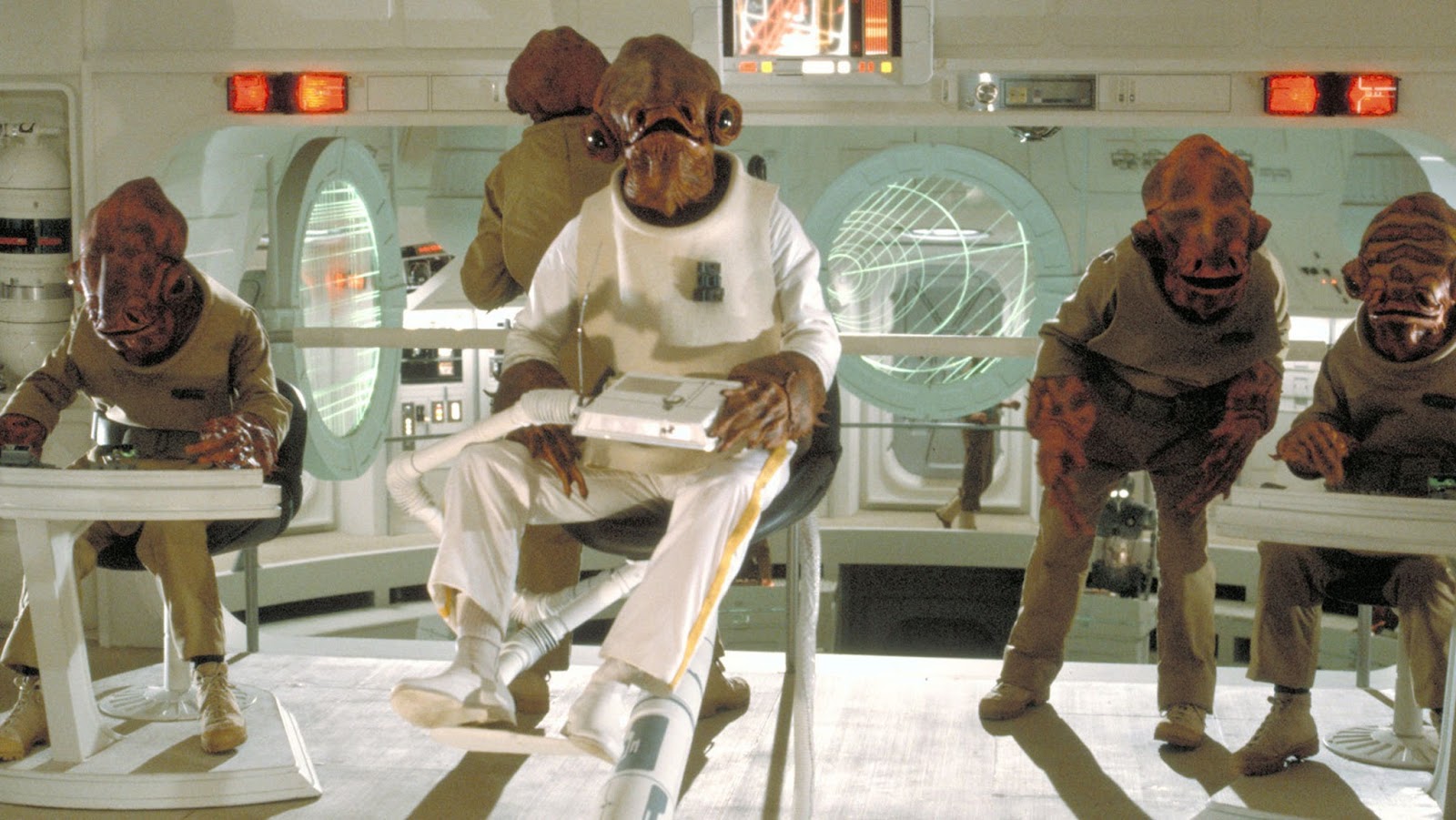
Out of the box, the Rebel Saboteurs are bald Duros aliens. I decided to re-create them as Mon Calamari (the least felicitously named race in the Star Wars universe). Slicing the Duros heads off was the work of a moment. Then I replaced them with the heads of two Admiral Akbar figures from Wizards of the Coast's old Star Wars range (these soft plastic figurines sell for just a couple dollars each on eBay - they often go by the name WotC Star Wars. There are so many miniatures in the range that they provide a nearly endless source of conversions.)

Next, I wanted to replicate the distinctive hands (fins?) of the Mon Calamari. So I shaped a little Greenstuff into their swollen, rubbery fore-arms and garnished them with tiny polyps. Finally, I refashioned the Durosian hands into claws. Presto! A new miniature.

I painted the Mon Calamari with the same colour scheme as my other Rebel forces - a buff, blue and black uniform based on the troopers aboard the Tantive IV at the beginning of A New Hope. The Mon Calamari skin is Terracotta, highlighted with ruddy fleshtones and capped with some dark brown spots, like port-wine stains.

Mon Calamari in their native environment

I've ordered a heap more Wizards of the Coast figurines, so I'm looking forward to more conversions in the future: Quarren, Aqualish and Ithorians... oh my!


Imperial Assault Rebel Saboteur, Mon Calamari Conversion

Fish heads, fish heads, rolly polly fish heads...

Imperial Assault Rebel Saboteur, Mon Calamari Conversion (rear)

Thanks for looking! If you've made any Star Wars conversions of your own, please let me know in the comments and I'll happily update my post with the link!

Thursday, July 9, 2015

Reading along with The Lord of the Rings: The Shadow of the Past

Chapter 2 of The Fellowship of the Ring

In Chapter 2, we encounter two shadows of the past. Gandalf tells Frodo that Sauron "has arisen again" to menace Middle-earth. And Tolkien reveals to us that he is haunted by the shade of Richard Wagner (1813-1883), composer of the opera Der Ring des Nibelungen (better known in English as "The Ring Cycle").


Jean de Reszke (1850-1925) in Der Ring des Nibelungen

The influence of the Ring Cycle on The Lord of the Rings is so obvious that it barely needs to be stated. Both works are closely linked to Norse and German myths, but much of the Ring Cycle is wholly Wagner's. The opera revolves around a magic ring that grants its wearer the power to enslave minds and rule the world. Importantly, this ring is accompanied by a magic helm (the "Tarnhelm") that makes its wearer invisible. The ring was first forged by the evil Dwarf Alberich from enchanted gold he stole from the Rhine river. But when the ring is stolen from Alberich, he places a heavy curse on it:
Whoever possesses it shall be consumed with care,
and whoever has it not shall be gnawed with envy!
Each shall itch to possess it,
but none in it shall find pleasure!
Its owner shall guard it profitlessly,
for through it he shall meet his executioner!
Forfeit to death,
faint with fear shall he be fettered;
for the length of his life
he shall long to die,
the ring's master
to the ring a slave!
This death-curse is so central to the plot that it even has its own recurring musical theme. For the rest of the Ring Cycle, we see how this curse ensnares all the characters in a tragic cycle of hubris and betrayal. It is inexorable. The giant Fafner clubs his brother to death so he can claim the ring. In turn, Seigfried kills Fafner and seizes it. Finally, Seigfried is treacherously stabbed in the back by the villain Hagen, who himself drowns (in a Gollum-like scene) when trying to grasp the ring as it is reclaimed by the flooding river Rhine.  

There are, of course, many other parallels between the Ring Cycle and The Lord of the Rings, including a sword that was broken, and a heroine that relinquishes the world of the gods for the love or a mortal man. But the central similarity is key: ultimate power (in the form of a ring) warps the hearts of all who would possess it, leading to an evil cycle where each owner is killed by his successor. 

And in The Shadow of the Past, Gandalf gives us Tolkien's version of this story: how Isildur cut the Ring from Sauron's hand but drowned in the Anduin River; how Smeagol killed Deagol; and how Bilbo stole the Ring from Gollum. Throughout it all, Gandalf makes it clear that the Ring has its own kind of curse:
"A mortal, Frodo, who keeps one of the Great Rings, does not die, but he does not grow or obtain more life, he merely continues, until at last every minute is a weariness. And if he often uses the Ring to make himself invisible, he fades... Yes, sooner or later - later if he is strong or well-meaning to begin with, but neither strength nor good purpose will last - sooner or later the dark power will devour him."
Just as Albrich sang, "for the length of his life, he shall long to die." Although Gandalf doesn't say that one of the Ring's owners will always be killed by the next, his brief history of Isildur and Gollum make it clear that possession  of the Ring is a kind of death sentence.

Now I wrote up above that the similarities between the Ring Cycle and The Lord of the Rings are so obvious that they don't need much elaboration. Just so. What interests me most is not the parallels between these works but the areas where Tolkien parts company from Wagner -- for it is the dissimilarities that are most revealing.

Most importantly, in Chapters 1 and 2 of The Fellowship of the Ring, we see that, unlike in Wagner, the curse of the ring can be interrupted. It is interrupted by Hobbits. A hobbit is a sort of anti-hero (certainly an anti-Wagnerian hero). Instead of beefy, ill-fated and oath-bound warriors like Seigfried and company, they are (in Gandalf's phrase) "soft as butter", but "full of surprises". The first rupture in the curse of the Ring occurred when Bilbo forbore from stabbing Gollum in the back during the events narrated in The Hobbit, and revisited at length in The Shadow of the Past. Here Gandalf makes it clear that Bilbo's decision to spare Gollum ultimately saved Bilbo from the curse:
"It was Pity that stayed his hand. Pity, and Mercy: not to strike without need. And he has been well rewarded, Frodo. Be sure that he took so little hurt from the evil, and escaped in the end, because he began his ownership of the Ring so. With Pity."
The second time that the curse was foiled is in Chapter 1, when Bilbo voluntarily gave up the Ring (60 years after his encounter with Gollum). It's easy to overlook the drama in this scene because it is so underwritten. But by my lights, it is one of the climaxes of the book (albeit a climax in the first chapter) -- and an example of Tolkien's writing at its finest. JRRT excels at portraying how characters struggle unconsciously against evil influence, from the dragon-greed in The Hobbit, to the voice of Saruman in The Two Towers. The understatement in Chapter 1 is delightful:
"Very well," said Bilbo, "it goes to Frodo with all the rest." He drew a deep breath.  
"And now I really must be starting, or somebody else will catch me. I have said good-bye, and I couldn't bear to do it all over again." He picked up his bag and moved to the door. 
"You have still got the ring in your pocket," said the wizard. 
"Well, so I have!" cried Bilbo.
After a long fight, Bilbo is finally able to let it go. It is this triumph that sets the rest of the plot in motion. But how did he do it? Tolkien doesn't quite tell us. His writing, as I say, is too understated to provide obvious answers. What we do know, however, is that Tolkien is infinitely more optimistic than Wagner. For Wagner, the tragedy of the ring is inescapable . But from the very beginning of his trilogy, Tolkien signals that there is something that can resist the death-curse of power. Something subtle and easy to miss. For the rest of The Lord of the Rings, we will discover more about what that something is.


To read on, here is my commentary on Chapter 3. Or You can find my commentary on Chapter 1 here.